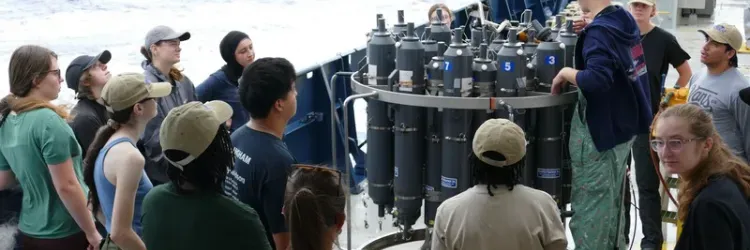
In an effort to provide more opportunities for early career scientists to gain the skills necessary to be good chief scientists, the STEMSEAS program has piloted the Chief Scientist Opportunities (ChOP) program as a component of its transit expeditions. Supported by a generous grant from the Maxwell-Hanrahan Foundation, ChOP is designed for post-doctoral and early career scientists who have some sea-going experience but have not yet had the opportunity to lead an expedition. During ChOP-led transits, the Fellows have the chance to collect data opportunistically, while also planning the expedition, mapping out the science activities of the transit and guiding undergraduate STEMSEAS students. They are supported by a senior scientist who sails with them and mentors them along the way. Students and other mentors are supported by the main National Science Foundation STEMSEAS grant.
The first ChOP transit took place on WHOI’s R/V Atlantis during its transit from Norfolk, VA to Panama City, Panama. The inaugural ChOP Fellows were Dr. Agata Piffer Braga and Dr. Theresa King. Dr. Braga is a seagoing physical oceanographer working as a postdoctoral scholar at the Scripps Institution of Oceanography. Dr. Theresa King is a postdoctoral fellow at the Colorado School of Mines. Both of them were able to develop a small research idea as a part of the application process to make efficient use of the 8 days at sea, while knowing that their overboard data collection activity could be limited by weather or sea-state conditions. Prior to sailing, they met with their mentor, Dr. Joe Montoya, several times via Zoom to learn about cruise-planning tools and organization, the process of requesting international clearances, writing
reports and managing science parties. Dr. Montoya is Professor of Biological Sciences and Director of the PhD Program in Ocean Science and Engineering at the Georgia Institute of Technology. He has served as chief scientist on numerous expeditions on Academic Research Fleet vessels and has led a number of prior STEMSEAS transits.
In the end, the group was able to do a total of 7 CTD casts and 8 ring net tows, collecting lots of interesting and useful data and samples for the ChOP Fellows and two URI graduate students also on board, while simultaneously exposing undergraduates to their techniques, processes and areas of research. The data will be used in future projects and proposals by the ChOP Fellows. In addition, the MH funding will support several students in conducting follow-up visits to the labs of Dr. Braga and Dr. King, to learn more about their institutions, do some data analysis, and make further connections in the field. Initial feedback from the transit indicates that the Fellows found the experience enriching in many ways, including opening up their eyes to broader areas of oceanography, inspiring future collaborations, working on their mentoring skills, and learning what goes into planning and leading a full science expedition.
The STEMSEAS program hopes to continue ChOP in upcoming years and is grateful to WHOI, the MH Foundation and NSF for support and partnership. For more information, contact Sharon Cooper: scooper5@uw.edu. Info on future expeditions and opportunities is at www.stemseas.org.