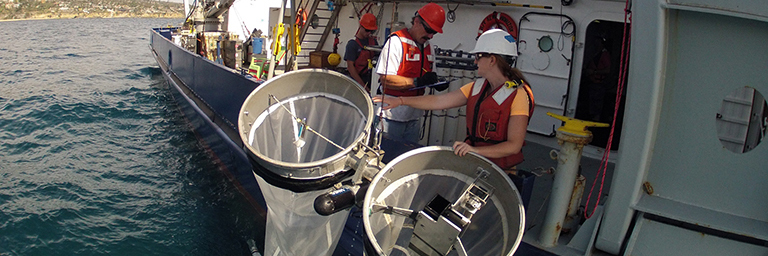
Having multiple UNOLS volunteers aboard our ADEON cruise was the difference between ending the cruise as a resounding success as opposed to merely accomplishing the science objectives. - Dr. Jennifer Miksis-Olds, UNH
Welcome to the UNOLS Cruise Opportunity Program Webpage!
The primary goal of the UNOLS Cruise Opportunity Program is to provide graduate students currently completing (or who have recently completed) a degree in a field of oceanographic research with the opportunity to participate in a research cruise. The participant will be a member of the scientific party and be involved in data collection and all other activities at sea. It is envisioned that the individual will be familiar with the science to be conducted at sea, and thus, form new collaborations and potentially develop new research directions. To be eligible to participate in this program, the individual must be either currently be studying at a U.S.-based institution or a recent graduate, and must have either a U.S. Passport or a U.S. Work Visa. Please note that you are responsible for paying for your travel to/from the ship (unless otherwise noted), the UNOLS Office is unable to provide travel funds; however your advisor or institution may have some ideas.
Please review the opportunities and apply by their deadlines listed below.
Note to PIs: If you have empty bunks on your cruise, please consider making them available to graduate students. Contact the UNOLS Office to coordinate. Thank you!
To be notified when new cruise opportunities become available, please sign up for the Cruise Opportunity email list.
Available Cruise Opportunities
Western and Central Aleutian Islands mercury and lower trophic sampling aboard R/V Sikuliaq
Application deadline: December 31, 2026
Application:
https://docs.google.com/forms/d/e/1FAIpQLScAob84Pnrq1dH87sc9rUcty0pZeoO…
We are excited to announce an Apply-To-Sail opportunity for US-based graduate students, postdocs, and early-career scientists to participate in a research cruise in the Central and Western Aleutian Islands, North Pacific Ocean aboard the R/V Sikuliaq, scheduled for late March – April 2027. Funded by the National Science Foundation, this research project aims to characterize mesozooplankton communities in the Central and Western Aleutian Islands and investigate where mercury is being converted to monomethylmerucry, a highly toxic form of mercury, within the marine environment and food web. Findings from this research will provide new information about the environmental drivers of increasing mercury, biomagnification, and spatial variability across the Aleutian Islands and the larger Arctic region. Understanding these processes is particularly important for Indigenous communities that depend on marine resources for subsistence, culture, and well-being.
Participants will gain hands-on experience collecting, processing, and analyzing a variety of oceanographic samples, including plankton nets, sediment core, trace metal clean water samples, water samples for nutrients and chlorophyll, and samples for post-cruise molecular work. Depending on their interests, participants will also have opportunities to contribute to shipboard experiments and sensor deployments. Science party duties will include assisting with sampling and laboratory analyses, participating in data discussions, and contributing to preliminary interpretation of results.
No previous shipboard experience or previous experience in physical, chemical or biological oceanography is required, and participants will receive full training onboard. Applications from graduate students and postdoctoral researchers are particularly encouraged. All members of the science party will be invited to participate in remote meetings before the cruise to discuss the science objectives, logistics, and sampling activities, helping to build a collaborative and supportive shipboard environment. This cruise offers a unique opportunity to work as part of an interdisciplinary team using state-of-the-art molecular, chemical, and biological techniques to investigate the endogenous production of methylmercury in arctic pelagic food webs.
Cruise dates: March 27 - April 20, 2027. Dates include mobilization and demobilization.
Principal Investigators: Jennifer Questel (University of Alaska Fairbanks; UAF), Carl Lamborg (California Stat University Santa Cruz), Mario Muscarella (UAF), Thilo Klenz (UAF), Amy Bishop (University of Alaska Anchorage), Benjamin Barst (University of Calgary)
Research Vessel: R/V Sikuliaq
Port: Seward, Alaska (departure and return)
Eligibility: Graduate students, postdocs, and early-career (<5 years post-PhD) scientists based at US institutions at time of cruise start. No citizenship requirements.
Application requirements: Please include a 2-page CV and a 1-page Statement of Interest (i.e. why you want to sail, what you hope to gain from the experience, and how it aligns with your career goals). Graduate student applications require a brief statement of support from an advisor or supervisor.
Expectations for participants: Applicants should be comfortable being on the open ocean, sharing a room with another scientist of the same gender (including a shared bathroom), and potentially have limited internet communications with the outside world. Applicants should be committed to carry out their assigned duties throughout the duration of the cruise. More information about doing collaborative science at sea, including policies related to safety and workplace culture may be found at https://www.unols.org/sites/default/files/RVSS_11thEd-12Nov2021.pdf.
Travel support and logistics: Partial travel support is available for selected participants and may cover lodging before and after the cruise and ground transportation to and from Seward and the Anchorage airport. We cannot cover flights or per diem for travel days. To maximise the number of participants we can support, applicants are asked to indicate whether they have access to other sources of travel funding. This information will be used only for logistical planning and allocation of travel funds. There are no costs for participation in the cruise itself; meals and lodging aboard the ship will be provided. No special gear is required besides normal work clothing and sturdy shoes and weather-appropriate outerwear, though steel-toed shoes are preferred for work on deck. R/V Sikuliaq can provide Mustang jackets and exposure work suits. There is no stipend to cover salary for participants.
Work conditions and physical requirements: Being at sea for extended periods on a research vessel can be physically and mentally demanding due to the remote nature of the work, rough seas and motion of the vessel, and reduced ability to stay in contact with family and friends. Sea sickness is common and can be severe. Seasickness treatments will be available. Physical requirements include navigating narrow hallways and climbing multiple flights of stairs while the ship is in motion. In addition, participants need to be able to put on safety gear including a life vest, hard hat, and emergency immersion suit. Medical services are extremely limited aboard the ship and participants should be aware that if selected they may be asked to disclose any medical conditions that may be difficult to manage at sea. These disclosures will be kept confidential and reviewed by the chief scientists and ship's captain. The captain has the authority to dismiss an individual on medical grounds related to safety at sea. The chief scientist has authority to dismiss an individual if the potential for medical diversion puts the planned scientific program at risk. Food is provided on the ship and prepared in a single kitchen, and most food allergies and restrictions can be accommodated.